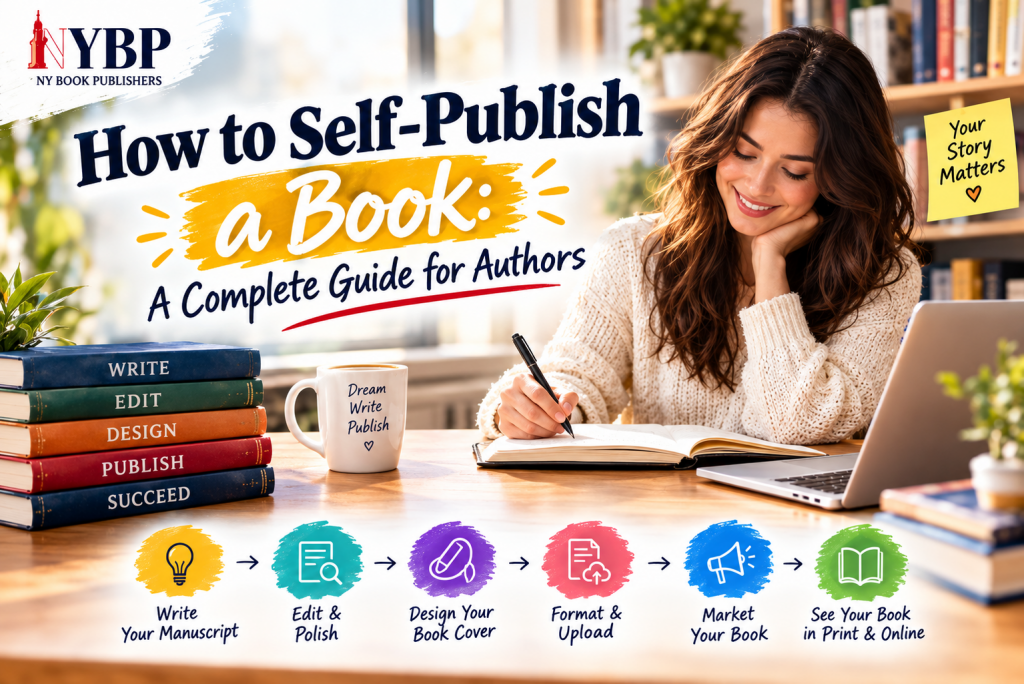
Overview
The idea that you need a traditional publisher’s permission to share your book with the world is outdated. Today, knowing how to self publish a book means having access to the same global distribution, professional production tools, and retail shelf space that traditional publishers use, without giving up your rights, your creative control, or the majority of your royalties.
Self-publishing has become a genuinely professional and commercially viable path for authors across every genre and every age category. Whether you are writing a novel, a children’s picture book, a poetry collection, a self-help guide, or a photography book, the tools and platforms to publish it professionally are available to you right now.
This guide walks you through the complete process, from finishing your manuscript to holding your published book, covering costs, platforms, and every important decision along the way. Self Book Publishers and professional book publishers can support you at every stage, and book publishers for new authors understand exactly what first-time authors need to get their book to market professionally and successfully.

How to Self Publish a Book: What It Actually Means
Before we get into the steps, it helps to be clear about what self-publishing actually involves in practice. When you self publish a book, you become the publisher. That means you are responsible for every aspect of bringing your book to market: the editing, the book cover design, the interior formatting, the ISBN, the distribution setup, the pricing, and the marketing. You either do these things yourself or hire professionals to do them for you.
The trade-off for carrying this responsibility is significant. You keep creative control over every decision about your book. You earn a dramatically higher percentage of each sale compared to a traditional publishing contract. You set your own timeline rather than waiting one to three years for a traditional publication date. And you own your rights completely.
The most common misconception about self-publishing is that it means doing everything alone without professional support. The best self-published books are produced with the same level of professional care as traditionally published ones: professional editing, professional cover design, professional formatting, and a real marketing strategy. What self-publishing means is that you are the decision-maker, not that you are the only person involved.
Step 1: Finish and Revise Your Manuscript
The first step in learning how to self publish a book is the same as the first step in any publishing path: actually finishing your book and making it as strong as you can before you show it to anyone or any professional service.
Write the complete first draft. Then step away from it for at least a week. Return with fresh eyes and read it through, making notes on structural issues, pacing problems, unclear passages, and anything that does not work. Address those notes in a second draft. Repeat this process until you are genuinely confident that the manuscript is as strong as you can make it on your own.
The biggest mistake first-time self-publishers make is rushing from a rough draft into production. A weak manuscript that gets beautifully designed and professionally printed is still a weak manuscript. The investment you make in production deserves a manuscript that is ready for it. Taking the revision stage seriously is how you ensure that investment pays off.
Step 2: Invest in Professional Editing
Professional book editing is the single most important investment you will make in your self-published book. It is also the step that separates the self-published books that readers trust and recommend from the ones that get one-star reviews for errors and poor quality.
There are several types of editing and most manuscripts benefit from more than one.
Developmental editing:
It addresses the big picture. A developmental editor looks at structure, pacing, character, argument, and overall coherence. They tell you if your story has a sagging middle, if your nonfiction argument has gaps, or if your character motivations do not hold up under scrutiny.
Line editing
It works at the paragraph and sentence level, improving clarity, flow, and voice without changing the substance of what you have written.
Copy editing
It is the technical polish pass. Copy editors catch grammatical errors, spelling mistakes, factual inconsistencies, and anything that slips through the earlier editorial stages.
Proofreading
This is the final quality check before your files go to the printer or the book publishing platform. It catches the last remaining errors that every manuscript has after all the other editing has been done.
How to successfully self publish a book always involves thorough professional editing. Readers cannot tell whether a book was traditionally published or self-published from the outside. But they can absolutely tell from the inside if editing was skipped, and they will say so in their reviews.
Step 3: Design a Professional Cover
Your cover is the most important marketing tool your book has. Before a reader reads your back cover copy, your opening paragraph, or a single review, they see your cover. It needs to do its job in about three seconds: signal the genre, create an emotional response, and communicate quality.
Professional cover design means working with a designer who understands your genre’s visual conventions, not simply creating something that looks attractive to you personally. A thriller cover, a literary fiction cover, a children’s picture book cover, and a poetry collection cover all follow completely different visual languages. Readers in each genre have strong intuitions about what their kind of book looks like, and your cover needs to speak those conventions fluently.
Cover designers who specialise in book covers typically charge between £200 and £1,000 or more depending on their experience and the complexity of the design. This is money well spent. A professional cover design has a longer commercial lifespan than almost any other investment you make in your book’s production.
If budget is very limited, tools like Canva offer book cover templates that allow non-designers to create serviceable covers. The quality ceiling of a Canva cover is lower than professional design, but it is significantly better than amateur design software used without templates.
Step 4: Format Your Interior
Interior formatting means preparing your manuscript file so that it reads and looks professional inside the book, whether in print or digital format. This involves choosing appropriate fonts, setting correct margins, creating consistent chapter headings, handling widows and orphans in the typesetting, and ensuring the overall reading experience matches the standards of professionally published books in your genre.
For print books, formatting requires creating a PDF file that meets the technical specifications of your printing platform. For eBooks, formatting requires creating an EPUB file that renders correctly across different e-reader devices and apps.
Tools like Vellum (Mac only), Atticus (available on all platforms), and Scrivener’s export function allow authors to format their own interiors to a professional standard with a manageable learning curve. Professional interior formatters charge approximately £100 to £400 for most book types.
Poor interior formatting is one of the clearest signals that a book has been self-published without professional care. Inconsistent fonts, incorrect margins, chapters that begin in odd places, and EPUB files that render strangely on Kindles all undermine the reading experience and the book’s perceived credibility.
Step 5: How to Self Publish a Book on Amazon KDP
Amazon Kindle Direct Publishing, universally known as KDP, is the most important self-publishing platform for UK authors and for most authors worldwide. Learning how to self publish a book on Amazon is central to any serious self-publishing strategy.
KDP gives you access to two distinct markets simultaneously. The Kindle store is the world’s largest eBook marketplace. KDP Print is a print-on-demand paperback service that produces physical copies of your book and ships them to readers as they are ordered, with no inventory required.
Here is how the process works on Amazon KDP:
- Create a KDP account at kdp.amazon.com. From your KDP dashboard, click to add a new title and choose whether you are publishing a Kindle eBook, a paperback, or a hardcover.
- Enter your book’s metadata: the title and subtitle, the author name or pen name, the book description which is effectively your back cover copy, the publishing rights status, your primary marketplace, and the categories and keywords that help readers find your book in Amazon searches.
- Upload your manuscript file and your cover file. Amazon’s online previewer allows you to check how your book will appear on different devices before you submit it for review.
- Set your pricing and choose your royalty structure. For eBooks, KDP pays 70% royalties on books priced between £1.99 and £9.99. Books priced outside that range earn 35% royalties. For paperbacks, royalties are calculated as a percentage of the list price after printing costs are deducted.
- Submit for review. Amazon typically reviews and publishes books within 24 to 72 hours.
How to self publish a book on Amazon for free is genuinely possible because KDP charges no upfront fees. You only incur costs if you choose to use KDP’s paid cover creation service or if you order author copies at the printing cost price. The platform itself is free to use, though of course you still need to fund your editing, cover design, and formatting independently.
How to self publish a book on Amazon UK specifically follows the same process, with Amazon automatically making your book available on amazon.co.uk as well as amazon.com and other global Amazon marketplaces when you set up your distribution through KDP.
KDP Select and Kindle Unlimited
Amazon also offers KDP Select, an optional programme that enrolls your eBook in Kindle Unlimited. Kindle Unlimited is a subscription service for readers where they pay a monthly fee and can read an unlimited number of enrolled books. Authors in KU earn money based on the number of pages readers read rather than per sale.
KDP Select requires 90-day exclusivity, meaning your eBook cannot be sold on any other platform during enrolment periods. For authors in genres where Kindle Unlimited readers are very active, including romance, fantasy, science fiction, and thriller, KU can generate significant income. For authors who want wide distribution across multiple platforms, exclusivity may not suit your strategy.
Step 6: Distribute Beyond Amazon
While Amazon KDP is essential, distributing your book beyond Amazon gives you access to additional readers and markets that many authors significantly underestimate.
IngramSpark
IngramSpark is the most important distribution platform beyond Amazon for UK self-published authors. Ingram is the world’s largest book distributor and their network supplies physical bookshops, libraries, online retailers, and academic institutions worldwide including Waterstones, Blackwell’s, and international markets.
Publishing through IngramSpark means your print book can be ordered by physical bookshops on a returnable or non-returnable basis. While bookshops rarely stock self-published titles proactively without a marketing reason to do so, the availability of your book through Ingram’s catalogue means that any bookshop can order it if a customer requests it.
IngramSpark charges a setup fee per title (typically around £30 to £49 per title format), though these fees are sometimes waived during promotional periods. The platform requires your files to meet specific technical standards that are somewhat more demanding than KDP’s requirements.
Draft2Digital
Draft2Digital aggregates your eBook distribution to multiple retailers including Apple Books, Barnes and Noble, Kobo, Google Play Books, and library platforms like OverDrive and Libby through a single upload. Draft2Digital takes a percentage commission on sales rather than charging upfront fees, which makes it accessible for authors who want wide distribution without significant upfront platform costs.
How Much Does It Cost to Self Publish a Book?
One of the most common questions from first-time self-publishers is how much does it cost to self publish a book in practice. The answer varies considerably depending on the quality level you aim for and which elements you handle yourself versus hire out professionally.
Here is a realistic cost breakdown for a professionally self-published book in the UK:
| Service | DIY / Budget Range | Professional Range |
| Developmental editing | N/A (your time) | £800 to £3,000+ |
| Copy editing | N/A (your time) | £300 to £1,200 |
| Proofreading | N/A (your time) | £150 to £500 |
| Cover design | £0 to £150 (Canva) | £250 to £1,000+ |
| Interior formatting | £0 to £50 (software) | £100 to £400 |
| ISBN (single, UK Nielsen) | £89 | £89 |
| IngramSpark setup | £30 to £49 per format | £30 to £49 per format |
| Marketing and launch | £100 to £500 | £500 to £3,000+ |
How much does it cost to self publish a book UK at the budget end, doing as much as possible yourself, you can self publish for as little as £200 to £400 including a basic cover, ISBN, and distribution setup. A fully professionally produced self-published book with professional editing, design, and formatting might cost £2,500 to £6,000 or more.
How much to self publish a book on Amazon specifically, through KDP alone, costs nothing in platform fees. Your costs are entirely the production services you commission before you upload.
How to Self Publish Specific Book Types
Children’s Book
How to self publish a children’s book involves significant additional considerations compared to text-only books, primarily because of the illustration costs. A professional children’s picture book illustrator typically charges between £1,500 and £8,000 or more for a complete 32-page picture book illustration project depending on their experience and reputation. This is the single largest cost in children’s book self-publishing and should be budgeted for carefully.
How to self publish a children’s book on Amazon is possible through KDP Print, which handles full-colour printing on a print-on-demand basis. However, full-colour print-on-demand has a significantly higher per-unit cost than black-and-white printing, which affects your pricing decisions and royalty calculations. Many children’s book self-publishers order a print run of 500 to 2,000 copies from a commercial printer to bring per-unit costs down to a competitive level.
How to self publish a children’s board book follows a similar process but requires specific binding and printing specifications that standard print-on-demand platforms do not support. Board books typically need to be printed commercially in short print runs rather than through KDP or IngramSpark.
Poetry Book
How to self publish a poetry book follows the same broad process as any other book but with some specific formatting considerations. Poetry collections need careful interior formatting to preserve line breaks, stanza spacing, and the visual presentation of individual poems exactly as the poet intends.
How to self publish a book of poems online through KDP and IngramSpark works well for standard poetry collections. The eBook format requires particular care because EPUB formatting does not always handle poetry line breaks consistently across different e-reader devices. Testing your poetry eBook on multiple devices and apps before publishing is strongly recommended.
How much does it cost to self publish a poetry book is at the lower end of the cost spectrum because poetry collections are typically shorter than novels and require no illustration. Professional editing, cover design, and formatting for a poetry collection might cost £800 to £2,500 in total for a professionally produced result.
Photography Book
How to self publish a photography book involves the most complex and most expensive production process of any self-published book type. Full-colour photography books require high-resolution image files, careful colour management throughout the production process, and premium paper and printing specifications to do justice to the photography.
How much does it cost to self publish a photography book depends significantly on whether you use print-on-demand or a commercial print run. Print-on-demand photography books through services like Blurb or IngramSpark are feasible but expensive per unit, often making commercial printing more economical for authors planning to sell significant quantities.
Comic Book
How to self publish a comic book requires sequential art formatting expertise alongside the standard book production process. Comic pages need to be set up at the correct resolution and bleed specifications for print. Panel layout, lettering, and colour management all require attention to detail that differs from prose book production.
Platforms like ComiXology Submit (now part of Amazon) and IngramSpark both support comic book distribution. Independent comic self-publishers also frequently sell directly from their own websites or at conventions, where the direct-to-reader model allows for better margins than wholesale distribution.
How to Self Publish a Book for Free
How to self publish a book for free is technically achievable through Amazon KDP’s no-upfront-cost model. KDP itself is free to use and provides a free ASIN for your book alongside the option of a free KDP-assigned ISBN (though this ISBN is owned by Amazon rather than by you).
If you are willing to use Canva’s free tier for your cover design, handle your own formatting using free tools like LibreOffice or Google Docs, and skip or defer professional editing, you can publish a book on Amazon at zero direct cost.
The realistic caveat is that completely free self-publishing almost always means skipping professional services that meaningfully affect your book’s quality and commercial performance. A book published for free without professional editing and design tends to read and look like it was published for free, which affects sales and reviews significantly.
How to self publish a book for free online while still maintaining professional quality is possible if you have relevant skills yourself, such as design experience for your cover or writing background for editing, and are willing to invest significant time in developing the areas where you lack expertise.
Obtaining Your ISBN
An ISBN (International Standard Book Number) is the unique identifier that allows your book to be tracked, ordered, and stocked by bookshops, libraries, and retailers. Each format of your book requires its own ISBN: the eBook, the paperback, and the hardcover each need separate ISBNs.
In the UK, ISBNs are purchased through Nielsen Book at isbn.nielsenbook.co.uk. A single UK ISBN costs £89 including VAT. A block of ten ISBNs costs £164 including VAT, making the block significantly better value if you plan to publish in multiple formats or plan multiple titles.
Amazon KDP provides a free ISBN for books published through their platform, but this ISBN is owned by Amazon and limits your flexibility if you later want to distribute through other channels. Purchasing your own ISBNs through Nielsen gives you full ownership and unrestricted distribution flexibility.
How Long Does It Take to Self Publish a Book?
One of the real advantages of self-publishing over traditional publishing is the timeline. A traditionally published book typically takes one to three years from signed contract to publication date. Self-publishing can move dramatically faster.
A realistic timeline for a professionally self-published book looks like this:
| Stage | Typical Duration |
| Manuscript revision | 4 to 12 weeks |
| Developmental editing | 4 to 8 weeks |
| Revisions after editing | 2 to 6 weeks |
| Copy editing and proofreading | 2 to 4 weeks |
| Cover design | 2 to 4 weeks |
| Interior formatting | 1 to 2 weeks |
| Platform setup and upload | 1 to 3 days |
| Amazon review period | 24 to 72 hours |
From a finished first draft to a published book, the process typically takes three to six months when done properly with professional support at each stage. Authors who rush the production process produce weaker books. Authors who take the time each stage deserves produce books that compete professionally.
How Easy Is It to Self Publish a Book?
The technical process of uploading a book to Amazon KDP is genuinely straightforward. The platform is designed to guide first-time authors through each step and the help documentation is comprehensive.
The harder parts of self-publishing are the parts that happen before you ever log into KDP: producing a manuscript that is genuinely ready to publish, making smart decisions about editing and design, understanding how to price your book competitively, and building the marketing presence that actually sells it once it is live.
How easy is it to self publish a book and have it sell? That is a more honest question, and the honest answer is that publication is easy but building readership requires sustained effort and smart strategy. The most successful self-published authors treat their books as businesses, investing in production quality and marketing consistently rather than publishing and hoping for the best.
Let NY Book Publishers UK Help You Self Publish Professionally
You do not have to navigate the self-publishing process alone. Having experienced professionals supporting your production decisions, managing your editorial process, and ensuring your book meets professional standards at every stage makes the difference between a book you are proud of and one you wish you had done differently. NY Book Publishers UK offers complete self-publishing support for authors of every type of book, from novels and memoirs to children’s books, poetry collections, and photography books. Their team brings professional expertise to editing, cover design, formatting, and distribution setup so that your self-published book competes at the highest level the market demands.
Time to Publish Your Book!
Knowing how to self publish a book is genuinely accessible in 2026. The platforms exist. The tools are available. The distribution networks that supply bookshops and libraries worldwide are open to independently published authors. The only question is whether you approach the process with the professionalism and preparation it deserves. Self-publishing done well produces books that readers cannot distinguish from traditionally published ones, that generate real income through royalties retained at a higher rate, and that give authors the creative control and ownership that traditional contracts often take away. Self-publishing done poorly produces books that confirm every outdated stereotype about independent publishing.
The difference between those two outcomes is not talent alone. It is the commitment to professional editing, professional design, and a genuine marketing strategy built before the book launches. Take every stage of the process seriously, invest where investment matters, and the result is a book you are genuinely proud to put your name on. When you are ready to take the next step, professional book publishers and self book publishers at NY Book Publishers UK are ready to help you bring your book to market the right way.
Frequently Asked Questions
How do I self-publish a book?
The core steps are: finish and revise your manuscript thoroughly, invest in professional editing appropriate to your book type, commission professional cover design and interior formatting, obtain an ISBN through Nielsen Book UK, upload your formatted files to Amazon KDP for eBook and print-on-demand distribution, set up distribution through IngramSpark for wider retail and library access, set your pricing, and build your marketing presence. Each step deserves genuine attention and professional support where your own skills have limits.
How much does it cost to self-publish a book?
Costs vary widely. Using Amazon KDP itself is free with no platform fees. A minimal self-published book using free tools and your own skills can technically cost as little as £89 for an ISBN. A professionally produced self-published book with editorial, design, and formatting support typically costs between £1,500 and £5,000 in the UK depending on the book’s length, type, and the level of professional involvement at each stage. Children’s picture books cost more due to illustration expenses.
Can I self-publish a book for free?
You can publish on Amazon KDP for free in the sense that the platform charges no upfront fees. If you use KDP’s free ISBN, handle your own cover design through free tools like Canva, and format your own interior using free software, the direct monetary cost can be very low. However, skipping professional editing and design consistently produces books that read and look unpolished, which affects reader reviews and long-term sales significantly. Investing in professional production almost always produces better commercial outcomes than publishing for free.
Do I need an ISBN to self-publish a book?
You need an ISBN if you want your book to be available through any retailer or library catalogue beyond Amazon. Amazon provides its own free ISBN for KDP-published books, but this ISBN is owned by Amazon and cannot be used on other platforms. If you plan to distribute through IngramSpark, list your book on Waterstones, or make it available through library systems, you need your own ISBN purchased through Nielsen Book UK. A single UK ISBN costs £89; a block of ten costs £164 and is better value if you plan multiple titles or formats.
How long does it take to self-publish a book?
The technical publication process on Amazon KDP takes 24 to 72 hours from upload to live listing. The full production process from finished first draft to published book, when done properly with professional editorial and design support, typically takes three to six months. Authors who rush the process to publish faster consistently produce weaker books than those who take the time each production stage genuinely requires. The investment of time in professional production pays back through better reviews, stronger word of mouth, and more sustained sales.